Inherited Wallet Recovery — A Practical Guide for Heirs, Executors, and Solicitors
In one paragraph. If a relative has died and left cryptocurrency behind, you are not in a unique situation, but you are in a complicated one. Crypto is property under English law, the executor's duty to identify and secure it is the same as it would be for a savings account, and the steps are well-understood. This guide explains the four ways inherited crypto presents itself, what a recovery firm like Arcana can (and cannot) do, what legal authority you will need first, and the red flags that mean someone is trying to take advantage of the estate. It is written to be read by an heir, an executor, or the family's probate solicitor. If you are a recovery professional reading this and you spot anything you would phrase differently — get in touch. We update our guides.
1. Why this guide exists
Cryptocurrency entered the consumer market around 2013-2014. The people who bought meaningfully in those years are now in their forties, fifties, sixties, and beyond. The earliest holders are starting to die — sometimes unexpectedly, sometimes after long illness, sometimes by accident. Their families discover, in the days and weeks after the funeral, that there is "something on a Ledger" or "Bitcoin somewhere" and have no idea what to do next.
In English law there is no special crypto regime for inheritance. Cryptocurrency is treated as property — confirmed by the High Court in AA v Persons Unknown [2019] EWHC 3556 (Comm) and reinforced by the Law Commission's 2023 report on digital assets. That means it forms part of the deceased's estate, it passes by will or under the rules of intestacy, and the executor or administrator has a legal duty to identify it, secure it, and distribute it in accordance with the will or the intestacy rules.
The complication is purely technical: unlike a bank account, there is no institution holding the funds on the deceased's behalf and no helpline to call. The seed phrase, hardware wallet PIN, or exchange password the deceased used is now the only thing standing between the estate and the asset. Recovering access without those credentials is what specialist firms do. Doing it lawfully, and without making the estate vulnerable to fraud or further loss, is what this guide is about.
2. Before you call anyone — what to gather first
A specialist recovery firm cannot engage with you until you have the legal authority to act on behalf of the estate and until we have a clear enough picture of what was left behind to scope the work. The two are independent: even if there is a clear seed phrase in a fireproof safe, no reputable firm will touch it without proof you are entitled to do so. Equally, even if you have a grant of probate in your hand, we cannot quote you for work we have not been able to scope.
Before contacting Arcana — or any recovery firm — gather the following.
2.1 Legal authority
- Grant of Probate (where there is a will) or Grant of Letters of Administration (where there is not), issued by the Probate Registry. A copy is sufficient for an initial conversation; a certified copy will be required before any technical work begins.
- A copy of the death certificate.
- The will, if there is one. The relevant clause is usually any general residuary gift or, less commonly, a specific bequest of digital assets. A modern will may have a "digital assets clause" — read it, but do not over-interpret it. The general residuary gift is sufficient in almost every case to pass cryptocurrency.
- A short note confirming who the executors or administrators are and which of them is taking the lead on the crypto question.
2.2 What the deceased left
This is the inventory step. Cast wide. Many estates discover crypto only by accident — an email from an exchange six weeks after the funeral, a hardware wallet box at the back of a sock drawer, a notebook with twelve words and no explanation.
| Look for | Where it is usually found |
|---|---|
| Hardware wallet device | Drawers, safes, safety deposit boxes, study desk, "tech drawer" in the kitchen |
| Paper seed phrase | Inside the hardware wallet box, in a fireproof document pouch, in a sealed envelope marked "important", behind a framed photograph |
| Metal seed plate (Cryptosteel, Billfodl) | Safety deposit box, fire safe at home, hidden compartment |
| Exchange account | Email archive (Coinbase, Kraken, Binance, Bitstamp, Gemini, Crypto.com — search for any of these) |
| Notes in writing | Diaries, address books, a "passwords" notebook, the back of utility bills, in the iCloud/Drive of the deceased |
| Old laptops or phones | The wallet may live as a hot wallet (Electrum, Exodus, MetaMask) on a device that no one has powered on in a year |
Do not move, open, or attempt to read anything you find yet. Photograph the outside of items where possible (the model of a hardware wallet, the cover of a notebook), note where each item was found and who else has seen it, and continue gathering. Premature handling of seed material is the single most common way estates lose value at this stage — a partial reading of a fading paper backup can change what is technically recoverable.
2.3 What the deceased said they had
If the deceased talked about their crypto holdings to anyone — a spouse, a child, an accountant, a financial adviser — write down what was said and who said it. "He told me about 12 Bitcoin he bought in 2013" is not legal evidence of ownership, but it is technical evidence that tells us what to look for. A recovery firm scoping the case will need both pieces.
If there is an accountant or financial adviser involved, ask them whether crypto appears anywhere in past returns. Even where it was not declared (and we make no judgement here), an adviser may know it existed.
3. The four entry paths
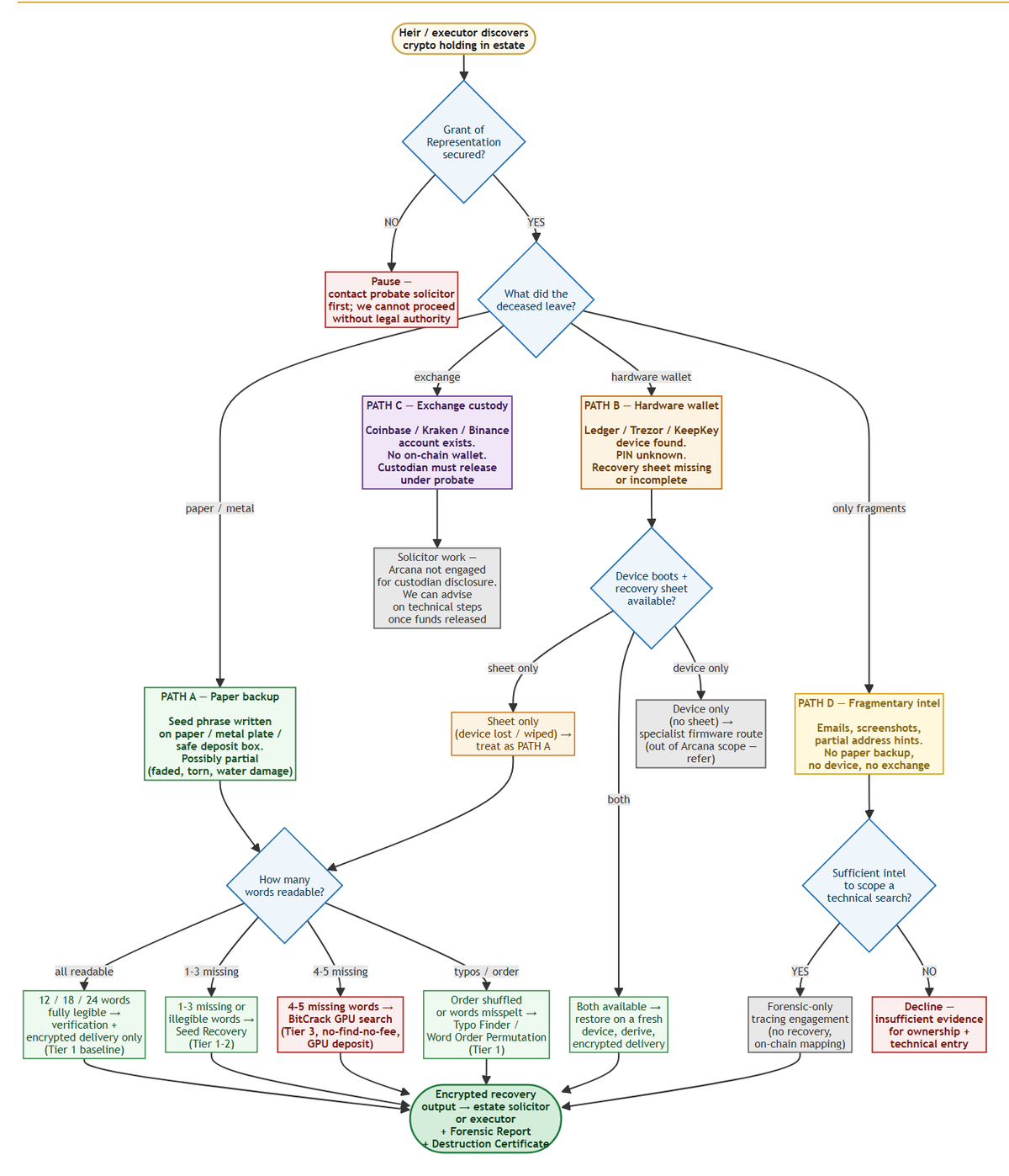
Once you have the legal authority and an inventory of what the deceased left, the technical question becomes: what do we actually have? There are four common entry paths to an inherited wallet, and the recovery approach differs sharply between them.
The diagram below is the decision tree we use ourselves at scoping. You can read it before reading the rest of this section — it should make the prose more concrete.
Path A — Paper backup found
This is the best-case outcome from a technical standpoint and, paradoxically, also the path that needs the most careful handling.
A paper or metal backup is a written record of the seed phrase — typically 12, 18, or 24 words, sometimes accompanied by a derivation path note or a passphrase hint. If you have found one, it is either complete and readable, or it is not.
- Fully readable. All words are present and unambiguous. The recovery work is essentially confirmation: we verify the seed produces the addresses the deceased's records suggest, derive the current balance, and produce an encrypted output for the estate. This is a Tier 1 engagement (see §7).
- Partially readable — 1, 2, or 3 words missing or illegible. This is the canonical missing-word recovery: a known partial mnemonic, a target address (from one of the deceased's records — a transaction confirmation email, a screenshot), and a controlled brute-force search across the BIP-39 wordlist. We have a separate guide for this — Seed Phrase Missing 1 Word. The inherited-wallet context adds the probate documentation layer but does not change the technical work. Tier 1 to Tier 2 depending on how many words are missing.
- Partially readable — 4 or 5 words missing. This is a Tier 3 engagement, governed by our no-find-no-fee model: combinatorics make a 4-word search 2048⁴ = ~17.5 trillion candidates, beyond a CPU-only timeline, so we route to GPU-accelerated search on our own hardware. The cost structure is different (a GPU deposit, refunded on success, charged on no-find) and it deserves a separate conversation — but it is the bread-and-butter case for inherited wallets from the early 2010s, where written backups have often faded or been damaged.
- Order shuffled, or words misspelt. Older holders sometimes wrote the words in a non-standard order, or in handwriting that produced predictable typos at transcription ("flie" for "file", "berr" for "bear"). Both are well-handled by standard recovery tools and are typically Tier 1 work. The estate equation is identical: legal authority + technical recovery + encrypted delivery.
In all four sub-cases the same procedural discipline applies: the seed material is treated by the recovery operator as cleartext sensitive data, the operation runs on an airgapped workstation, the recovered output is encrypted before it leaves our environment, and a 72-hour hard-delete clears every working copy after the estate confirms receipt. We describe this in §6 below.
Path B — Hardware wallet found, PIN unknown
A Ledger, Trezor, KeepKey, or similar device has surfaced in the estate. The device boots — or it does not — and the PIN is unknown.
The handling depends on what else is in the estate.
- Device and recovery sheet both present. The recovery sheet (the 12 or 24 words written down at device setup) is the canonical recovery route. We do not attempt to bypass the device PIN; we restore the seed to a fresh device or derive its addresses offline, produce the encrypted output, and the original device can be wiped and disposed of or kept as a keepsake. This is Tier 1 work.
- Recovery sheet only — device lost, broken, or wiped. This is functionally a paper-backup case (Path A). The device was a convenience; the words are the asset.
- Device only, no recovery sheet. This is the most awkward case. Modern hardware wallets are designed precisely to resist seed extraction without the PIN. There is a narrow specialist firmware-extraction route for some older Trezor One devices, but it is out of scope for Arcana Crypto and we do not undertake it. We refer estates in this situation to the small number of firms internationally that do, with an explicit warning that fees in that space are high and outcomes are uncertain.
For the broader hardware wallet picture — restoring, deriving across coin types, the safety procedure for handling an inherited device — see our Hardware Wallet Recovery (Ledger/Trezor) guide. The estate scenario adds nothing technical to that guide; it adds the probate authority requirement.
Path C — Exchange custody
The deceased held crypto on a centralised exchange — Coinbase, Kraken, Binance, Bitstamp, Crypto.com, Gemini. There is no on-chain wallet to recover because the keys were never in the deceased's hands; the exchange holds them.
This is not a recovery firm's work. It is the estate solicitor's work. Every major exchange has an "deceased account" or "estate" procedure that takes the grant of representation, the death certificate, and an executor's instruction, and releases the balance — either to a nominated bank account (most common) or, on request, to a fresh wallet the estate controls.
The procedure is slow (typically four to twelve weeks), bureaucratic, and varies sharply between exchanges. The estate solicitor will run it. Where the estate then wants advice on how to handle the released funds — moving them off the exchange to a self-custody wallet for distribution, valuing them at probate, recognising the chargeable gain on disposal — that is a conversation we are happy to have, but the technical recovery question does not arise.
A note on dormant or partially abandoned exchange accounts: where the deceased opened an account years ago, deposited, and lost touch with it, the funds may still be there. The estate's lawful route is the formal estate procedure. Anyone — including us — offering to "extract" the funds without going through that procedure is offering to commit a criminal offence on the estate's behalf, and the estate would inherit the consequences. We will not do it. Neither should any other reputable firm.
Path D — Fragmentary intelligence only
Sometimes the estate knows only that the deceased held crypto — there is an old transaction confirmation email, a screenshot, a sentence in a diary — and no backup, no device, no exchange account.
This is the hardest case and the one most often associated with scams targeting estates. The honest answer is that without enough evidence to scope a technical search, recovery is not possible. There are, however, two narrow exceptions:
- Forensic-only tracing. Where we have one or more addresses the deceased controlled, we can produce an on-chain tracing report — current balance, movement history, last known activity. This does not recover funds; it documents what is there. It is sometimes useful for the estate's tax return, for the inheritance valuation, or for litigation where funds appear to have moved post-mortem in suspicious circumstances. Pricing is per-hour or fixed, and we are explicit that this is investigation work, not recovery.
- Lost-key recovery on bounded evidence. Where the estate has a single private key fragment, a partial brain-wallet passphrase, or sufficient information to scope a bounded search, we can sometimes engage at Tier 3. This is rare and we will tell you straightforwardly during scoping whether your case fits.
In all other Path D situations the right answer is to decline. We will say so. If a recovery firm is willing to take money from an estate in a Path D situation without explaining what they will actually search and how they will know when to stop, that firm is taking advantage of the estate.
4. What Arcana can and cannot do
The scope of a recovery engagement on an inherited wallet is narrower than people sometimes imagine. It is worth being explicit, because the gap between expectation and reality is where misunderstandings — and complaints — tend to arise.
Arcana Crypto can:
- Perform technical recovery on Path A and Path B (where appropriate evidence is present), under documented authority from the estate.
- Produce an encrypted recovery output, delivered to the estate's nominated solicitor or executor by a two-channel protocol (Proton encrypted attachment + Signal-delivered password).
- Issue a signed Forensic Report documenting what we received, what we did, what we produced, and the hashes that prove the chain.
- Issue a signed Destruction Certificate confirming that no copy of recovered material remains in our hands after delivery.
- Provide a forensic-only tracing report where Path D scoping permits.
- Refer to specialist firms where the work is outside our scope (e.g. firmware extraction on older Trezor devices).
Arcana Crypto cannot:
- Provide legal advice on probate, intestacy, the will, or the distribution of assets. We work alongside the estate's solicitor; we do not replace them.
- Bypass an exchange's deceased-account procedure or any other lawful custodian process.
- "Hack" anything — including the deceased's email, cloud account, or device. Where credentials to an environment owned by the deceased are not part of the recovery surface (and they almost never are — we work with the cryptographic material directly), we do not attempt to access them.
- Take possession of recovered funds. We do not, ever, hold a recovered wallet on the estate's behalf. The encrypted output is delivered to the estate; the estate moves or holds the funds.
- Work on a percentage of recovered value. Our fees are fixed Tier-banded amounts agreed in advance. This is deliberate — see §7 below.
The first line is the most important one in this guide: we do not hold or move the estate's funds at any point. A recovery firm offering to do so is offering to take custody. Custody is a regulated activity in the UK, and a firm doing it without registration is committing a regulatory offence. More practically: a firm that holds your funds for "operational reasons" is a firm whose insolvency, fraud, or simple administrative chaos becomes your problem. We architected our service specifically to avoid this exposure.
5. Why we ask for legal authority — the anti-fraud architecture
A recurring frustration we hear from heirs is some version of: "My father is dead, the wallet is his, I am his only child, why do you need a grant of probate?"
The answer is that we have no independent way of knowing any of those statements are true. Crypto recovery is a service whose attack surface is exactly this: someone who is not the lawful heir presents themselves as the heir, produces the seed material (which may have been obtained by theft, by domestic-abuse coercion, by simple opportunism in the days after a death), and asks us to do the work. From our side the transaction looks identical to a legitimate engagement, and the cryptographic material itself carries no information about who owns it.
The grant of probate or letters of administration is the proxy: the Probate Registry has verified, through its own procedure, that the person presenting it is entitled to act on behalf of the estate. Where the grant exists, we are operating on the back of that verification. Where it does not, we are operating on the back of someone's word, and we are not in the business of doing that.
Two further layers reinforce this:
- KYC on the executor. We perform the same identity-verification on the executor or administrator that we would on any client. Passport or driving licence, proof of address, and a short call. This is not a probate check; it is the standard UK money-laundering regulation check, and it is non-negotiable.
- Conflict screening across beneficiaries. Where multiple people stand to inherit, we will ask the executor for the beneficiary list and confirm that the executor is acting with the beneficiaries' consent. We will not act for one heir against another. Where a dispute exists, we will pause the engagement until it is resolved or until the court has spoken.
If this seems heavy-handed, consider the alternative. A recovery firm that does not impose these checks is also the recovery firm that will be exploited by a step-relative cutting other heirs out, by an estranged spouse acting before the will is read, or by an outright fraudster impersonating a dead person's child. Estates have lost meaningful value to all three patterns. We are not willing to be the channel.
6. What a recovery actually looks like — the process in brief
Where the case fits Path A or Path B and the legal authority is in place, the engagement runs as follows.
| Step | What happens | Typical timeline |
|---|---|---|
| Initial scoping call | A free 30-45 minute call. We review what the estate has, identify the path, and tell you whether we can engage and at which Tier. No commitment either way. | Same week |
| Engagement letter | A written contract — fees, scope, deliverables, deletion timeline, liability cap. We do not begin work until it is countersigned. | 24-48h after scoping |
| Material handover | The estate transmits the seed material, hardware wallet image, or other artefacts to us. We accept by encrypted attachment (Proton) or by encrypted media. We hash everything on receipt — the start of the forensic chain of custody. | Day 1 of work |
| Sensitive operation | The actual recovery work runs on an airgapped workstation. For a Tier 1 case this is minutes to hours. For a Tier 2 case it is hours to days. For Tier 3 it can run multiple days on GPU. The estate is kept informed in writing. | Per Tier |
| Encrypted delivery | The recovered material — typically a private key or seed — is encrypted into an .arcana.enc file and delivered by two-channel protocol (the file by Proton; the password by Signal). |
Within 24h of recovery |
| Confirmation of receipt | The estate confirms it has decrypted and accessed the wallet. Funds at this point are entirely in the estate's hands. | Day of delivery |
| Destruction Certificate | Within 72 hours of confirmation, every working copy of the material in our environment is securely deleted. A signed Destruction Certificate is issued. | Within 72h of confirmation |
| Forensic Report | A signed PDF documenting the chain of custody from intake to delivery. Suitable for the estate's records, the solicitor, and any future audit. | Within 7 days |
The procedural backbone of this — the airgapped operation, the forensic chain, the two-channel delivery, the 72-hour deletion, the signed report — is the same for every engagement, whether the estate is recovering 0.5 BTC or 50 BTC. The discipline is fixed; the technical work flexes by Tier.
7. Costs — Tier mapping and why we don't take a percentage
Arcana works on fixed Tier-banded fees agreed in advance. The Tier is determined at scoping, before the engagement letter is countersigned, on the basis of what is technically required.
| Tier | Recovery work | Typical fee |
|---|---|---|
| Tier 1 | 1-2 missing words; typo or word-order correction; seed verification and derivation | £300 - £1,000 |
| Tier 2 | 3 missing words; passphrase recovery; derivation-path search; wallet.dat password | £500 - £2,000 |
| Tier 3 | 4-5 missing words (GPU-accelerated); ECDLP search; brain-wallet recovery | From £2,000, no-find-no-fee with GPU deposit |
| Forensic-only | On-chain tracing report | £500/h or fixed per scope |
We do not work on a percentage of recovered value. Here is why this matters for an estate.
Percentage models — "we take 20% of what we recover" — sound attractive when the wallet is empty and become predatory when it is not. A 20% fee on a £400,000 recovered wallet is £80,000 — disproportionate to the work performed and unjust to the beneficiaries. They are also a structural conflict: the firm is incentivised to inflate complexity, to retain custody, and to delay delivery. We have seen all three.
A fixed Tier-banded fee is honest. The estate sees the bill before the work begins, the bill does not change because the wallet turned out to be larger than expected, and the firm's incentive is to do the technical work efficiently and hand the asset back.
Where the technical work genuinely cannot be scoped in advance — typically Tier 3 cases — we run a no-find-no-fee model with a GPU deposit. The deposit covers the hardware cost of the search; it is refunded if we do not recover; it is converted to a Tier 3 fee if we do. This is the only situation in which our fee structure is conditional on outcome, and the conditions are written into the engagement letter.
8. What NOT to do — red flags and scam awareness
The scam ecosystem targeting estates is large and growing. Heirs are emotionally exposed, legally inexperienced, and often unfamiliar with the technical landscape. The following patterns should set off alarms. They are not exhaustive — when in doubt, ask the estate solicitor before acting.
- "Send us the seed phrase and we'll tell you what's there." A reputable firm will not ask for cleartext seed material before a scoping call, an engagement letter, and verification of authority. Anyone who asks for it on first contact is either fishing for valid wallets to drain or, at best, deeply unprofessional.
- "Upfront payment in crypto." A firm legitimately operating in the UK invoices in pounds sterling, accepts payment by bank transfer or by card, issues a VAT-bearing invoice, and is registered with Companies House. A firm requiring payment in BTC or USDT to a personal address is doing so because they do not want to be traceable. That fact alone is the answer.
- "We can hack the exchange / bypass the device PIN / recover from anything." Marketing copy that claims universal capability is marketing copy. Hardware wallets and major exchanges are designed by adversarial security teams; "anything" is not technically possible, and a firm claiming it is is either lying or deluded.
- "Don't tell the solicitor yet." Any pressure to bypass the estate's solicitor is a red flag the size of a building. The solicitor is the estate's first line of protection against everyone, including us.
- "We'll hold the funds for you and distribute them to the beneficiaries." A recovery firm offering to handle distribution is offering to commit a regulated custody act it is not registered to perform, and to expose the estate to its operational risk. The funds go to the estate's solicitor or to the executor; they do not stop with the recovery firm.
- YouTube and Reddit "recovery experts" offering DM consultations. The platforms do not vet them; the platforms host advertising for them. Some are legitimate freelancers; most are not. Verify any individual via Companies House, FCA register check (for activity scope), and a real address before sharing anything.
- Inbound contact from someone who claims to "know about" the wallet. If a stranger reaches out to the family in the days after a death claiming knowledge of the deceased's crypto, treat this as an attempt to exploit. Verify identity, do not transmit seed material, document the contact, and tell the solicitor.
If the estate has already been approached by a firm or individual you are not sure about, you are welcome to send the details to our intake email — we will not represent another firm to you, but we will tell you what we can see about them.
9. Frequently asked questions
Does crypto pass under a will if it is not specifically mentioned? Yes. Cryptocurrency forms part of the deceased's general estate and passes under any general residuary gift. A specific clause is not required, though modern wills increasingly include a digital-assets clause for clarity.
What value is crypto recorded at for inheritance tax? The value at the date of death, in pounds sterling, on a recognised exchange. HMRC will accept a sensible valuation from a major exchange (Coinbase, Kraken, Binance) on the date of death; volatility around the date is not a basis for revaluing.
Can we recover a wallet if the deceased used a passphrase ("25th word") on top of the seed? Sometimes. Where the passphrase is known or strongly suspected (a recurring word the deceased used, a phrase from a meaningful event, a hint in the estate documents), we run a guided dictionary or pattern search. Where it is entirely unknown the recovery may be infeasible. We will tell you at scoping which side of that line the case sits on. See our BIP39 Passphrase Recovery guide for more.
The deceased held on an exchange. Why do we need a recovery firm at all? Generally you do not. The estate solicitor runs the exchange's deceased-account procedure. We can assist if the released funds then need to be moved to self-custody or distributed in a non-standard way.
How long does an inherited wallet recovery take? From first contact to delivery: typically two to four weeks for a Tier 1 case, four to eight weeks for Tier 2, six to twelve weeks for Tier 3. The probate and KYC stages drive most of the calendar time; the technical work itself is usually a small fraction.
Do you work outside the UK? We engage with estates where the executor or administrator is in the UK, EU, or a jurisdiction we have screened (see our jurisdictional policy). We currently do not engage where the estate is in the United States or Canada — a regulatory choice, not a technical one. Estates in those jurisdictions are referred to specialist firms there.
Is the recovery process insured? We carry professional indemnity and cyber insurance with Hiscox covering our recovery activity. The policy details are summarised in the engagement letter and are available on request.
What happens to our material if the recovery fails? The forensic chain of custody applies whether or not the recovery succeeds. Material received is hashed, retained in encrypted form for the engagement's duration, and securely destroyed under the same 72-hour rule. A Destruction Certificate is issued in both outcomes. The Forensic Report documents what was attempted and why it did not succeed.
Can the estate's solicitor be present during the recovery work? Not literally — sensitive operations run on an airgapped workstation with no remote-observation channel by design. The solicitor can attend a pre-work call, see the engagement letter, and receive the Forensic Report. Where independent observation is specifically required (e.g. high-value engagements or estates in litigation), we can arrange a third-party witness procedure at additional cost.
We think the deceased may have been a victim of a crypto scam. Is this still a recovery question? Probably not, but we can help triage. Recovery from a confirmed scam is a different specialty — typically on-chain tracing to support a civil claim, sometimes a coordinated effort with the receiving exchange's compliance team. We can produce the forensic tracing report (Path D above) and refer the estate to specialist litigation counsel for the next step.
10. Working with us
We work directly with executors, administrators, and estate solicitors. If you are an heir without the legal authority yet, we will pause the conversation, point you to the Probate Registry and to a probate solicitor if you need one, and pick up once the grant is in your hands. We have a small panel of UK probate solicitors we can refer to where helpful, with no commercial relationship — they pay us nothing for the referral.
To start a conversation, write to legal@arcana-crypto.com with: a one-paragraph summary of what the estate has discovered, a copy of the grant (or the application reference if not yet issued), and a contact number we can call. We aim to reply within one working day. The initial scoping call is free and carries no commitment.
If you are an estate solicitor acting for the family and would prefer to introduce us before involving the family directly, that is the route we usually prefer. Email the same address with your firm's reference and we will respond accordingly.
A closing note. Cryptocurrency in estates is, for a long time yet, going to be the most technically opaque asset class an executor encounters. The legal framework is in place; the technical recovery is well-understood; the procedural discipline to do it without exposing the estate to fraud or further loss is not optional. If this guide raises questions we have not answered — or if you spot something a specialist solicitor or fellow recovery professional would phrase differently — write to us. We update our guides.
Arcana Crypto LTD — registered in England and Wales (no. 16371124). Recovery and forensics for cryptoasset estates and individual wallet-loss cases. UK + EU engagements. Sole Director: R. Macri.
Guide version 1.0.1 · Published 28 May 2026 · Last reviewed 31 May 2026 · Reviewed by counsel. This guide is general information, not legal or financial advice. The estate's solicitor and accountant remain responsible for advice on the estate's specific circumstances.